What makes a loyalty program stand out?

Some loyalty programs are rejected outright. But most just aren’t felt strongly enough to matter.
Loyalty programs are not new to customers. They’ve become a familiar and even ubiquitous part of life, expanding and proliferating steadily across categories and industries. Grocery stores, airlines, medical aids, beauty salons, your local pizzeria … they all have loyalty programs.
Despite this – or perhaps because of it – customers are not indiscriminate. Most are selective about which programs they feel are worth joining, and even more selective about which ones deserve their ongoing attention. Many programs are considered and rejected. Others are joined, but are active only technically, and not meaningfully engaged with. Customers filter which programs they use, and how much.
In short, there are more loyalty programs than ever, but they’re not just competing to attract members. They’re competing to sustain engagement, and to grow the very thing they set out to: loyalty.
A tale of two perspectives.
On the surface, many loyalty programs appear similar, with familiar structures: spend leads to points, points lead to rewards. From the company’s or brand’s perspective, these mechanics are often thought-through, well-designed, and clear.
From a customer’s perspective, however, the experience of two similarly structured programs can be very different. What matters to them isn’t mechanics alone. It’s how the whole experience unfolds, and how it feels to participate in it.
A program may be logical, generous, and well-constructed, but still fail to hold attention. Not because it’s structurally flawed, but because it doesn’t create a strong enough emotional response to matter. Customers don’t engage with loyalty programs simply because they work. They engage because the experience feels worthwhile.
The emotional spectrum.
A useful way to understand this is to think of the loyalty program experience not as fixed or binary – either good or bad – but rather as a spectrum of how customers’ experiences feel.
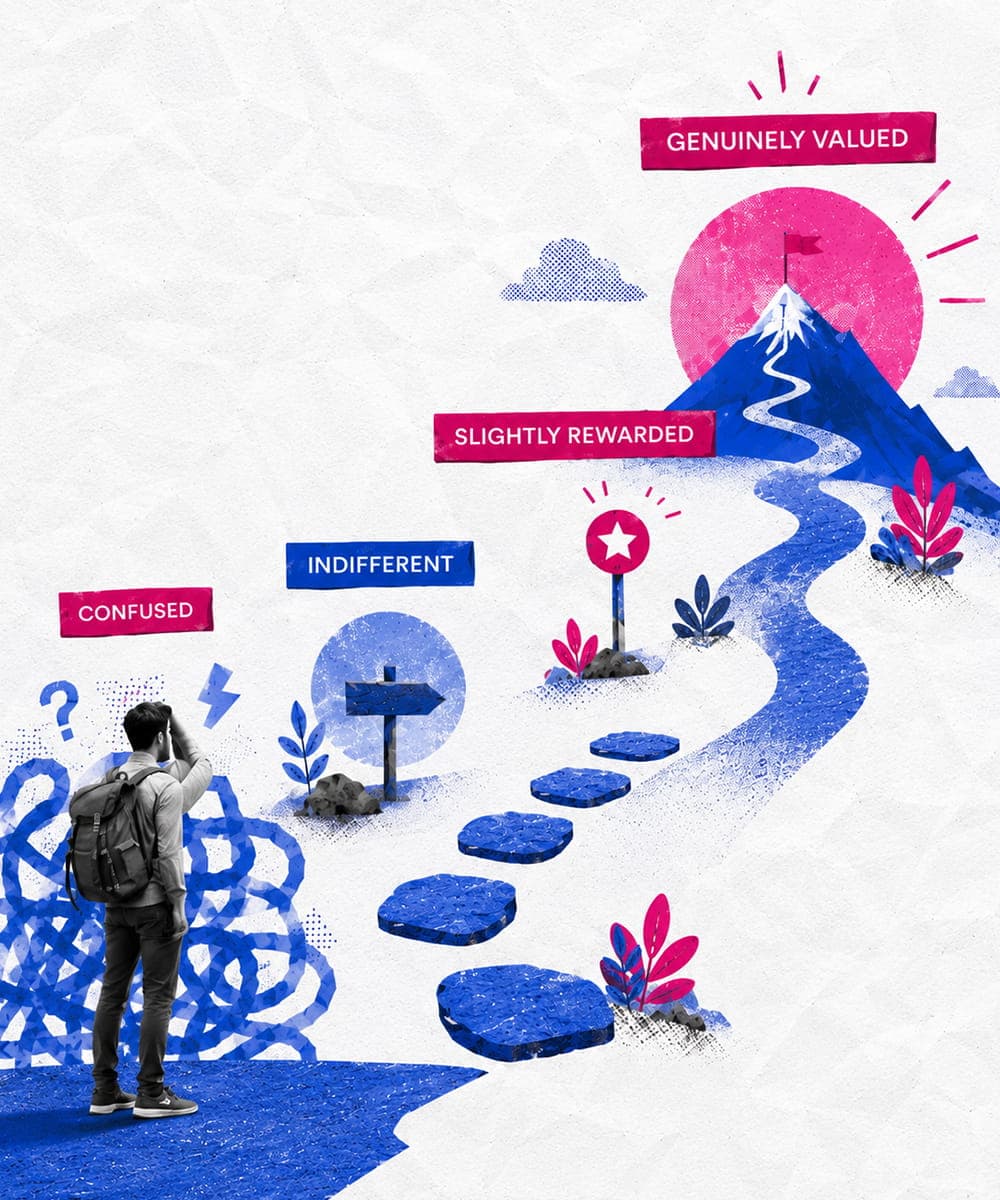
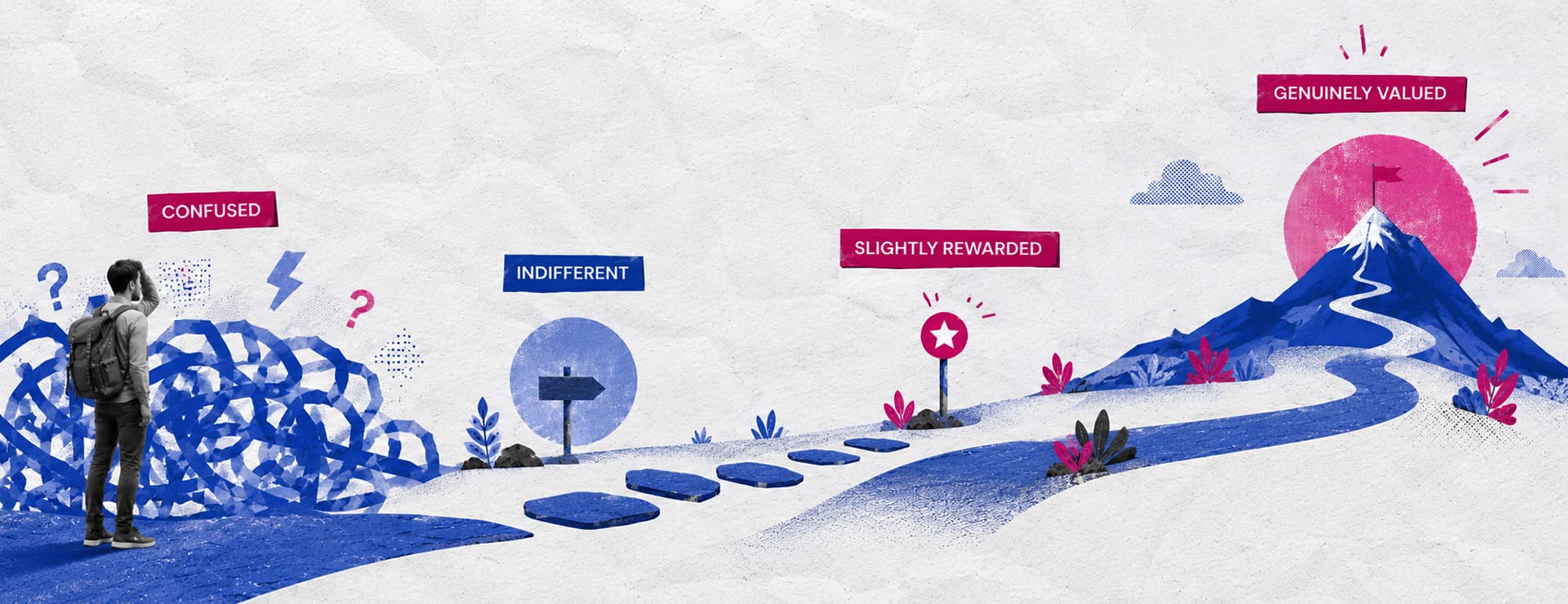
At one end, there’s confusion: here, the program feels difficult to understand, the value is unclear, and it takes effort just to make sense of it. In these cases, disengagement is immediate, and the program isn’t just ignored, but quickly rejected.
Moving along the spectrum, there’s indifference: the mechanics are understood, but the experience doesn’t feel compelling. There may be some value, but not enough for the program to stand out or stick. Engagement is mild at best, and only occasional, probably fading over time.
Further along, there’s a sense of being somewhat or slightly rewarded: the customer receives something in return, and there’s a recognition of value. But the experience remains largely transactional. It meets expectations, but rarely exceeds them.
At the far end of the spectrum is something more meaningful for customers – a feeling of being genuinely valued: the program feels considered, relevant, easy and even enjoyable to engage with. But, more than that, it makes customers feel appreciated and valued, and gives them a reason to return, not just because of what’s offered, but because of how it feels to participate.
Most programs operate somewhere in the middle of this spectrum. They function. They deliver value. But they don’t consistently create a strong enough experience to move customers towards that deeper sense of connection.
In a crowded environment, this is what differentiates a program that quietly recedes in a customer’s mind from one that the same customer wants and chooses to engage with repeatedly over time.
What makes an experience genuinely valued?
What shapes the loyalty experience isn’t just features, but feelings. And there are various signals that will make those feelings negative or positive based on their absence or presence.
Ease: At the most fundamental level, ease is non-negotiable. A program that’s difficult to understand or requires effort to navigate quickly pushes customers towards confusion, and rejection of the program. Participation should feel intuitive, and the path forward should be clear. Ease is table stakes: without it, no customer will move very far along the emotional spectrum.
Attainability: As an extension of ease, progress needs to feel within reach. If rewards feel too distant, or if the effort required to earn them feels disproportionate, motivation weakens. Visible progress, achievable milestones, and a sense of momentum all contribute to the feeling that participation is worthwhile.
Relevance: Beyond ease and attainability, signals start to shape the customer’s experience more meaningfully. When communication, rewards, and interactions align with what matters to the individual, the program starts to feel considered rather than generic. On the other hand, without relevance, even a financially valuable reward can feel unexciting.
Personalisation: In a way, personalisation builds on relevance. Although data can play a huge role in personalisation, from the perspective of the participant’s experience, it’s really about a feeling of recognition. It’s the difference between something that could apply to anyone, and something that feels directed at me. One well-known online South African retailer pretty much built its brand by sending hand-written messages with every order. Even if there’s a point at which that kind of personalisation may be difficult or impractical to scale, it gives customers a rare feeling of being recognised and cared for.
Delight: At the more powerful end of the experience, delight is where the program exceeds expectations. A charming message, an unexpected benefit, a well-timed reward, or a moment of recognition can really elevate the experience and create a sense that there is more here than just a simple exchange. That same retailer that hand-wrote messages wasn’t just personalising the experience, they were making it delightful.
Memorability: Ultimately, what’s critical is what is remembered and, more specifically, how it’s remembered. Lack of memorability means indifference for customers, and will keep the program in the forgettable middle of the spectrum. Experiences that leave a good and lasting impression are far more likely to positively influence future behaviour. This is why incentive travel is considered the ultimate reward – it creates lifelong memories.
These signals don’t operate in isolation. They reinforce one another. Choice can increase relevance, but too much choice can introduce complexity, undermining ease. Recognition can strengthen personalisation, but only if it feels genuine. Smaller, more frequent rewards can improve attainability, while also creating moments of delight. The experience is cumulative, shaped by how these elements come together over time.
Indifference is the enemy.
Not all disengagement looks the same.
At the lower end of the spectrum, confusion leads to outright rejection, and customers quickly opt out.
But more often, programs sit in the indistinct, mushy middle. They‘re understood, but not compelling. They function, but don’t resonate. They feel okay, average, not bad, not great. Just meh. In these cases, the risk is not dissatisfaction, but indifference.
And indifference is more difficult to detect. There’s no clear moment of exit or explicit decision to disengage. Instead, there’s a gradual decline in attention: I could use this, but I don’t really think about it. It’s there, but it doesn’t make much difference.
Over time, this is what causes programs to lose relevance, even when they continue to operate as intended.
Efficiency matters, emotion matters more.
In a crowded loyalty landscape, standing out is rarely about ticking boxes or offering more of the same. A program needs to work, and work well – but that is a minimum requirement. What sets a program apart is how it feels to be part of it. Because loyalty, at its core, is more than a rational calculation. It’s a pattern of behaviour that is reinforced by someone’s subjective perceptions and experiences.
Two programs may offer similar value. The one that feels clearer, easier, and more relevant will be the one that earns attention. The one that creates moments of recognition, that is delightful enough for customers to mention it to their family and friends, and that leaves a lasting impression for all the right reasons, will be the one that is returned to.
Move from the mushy middle to the genuinely valued.
Want a customer loyalty program so delightful, and so memorable, that it becomes indispensable to your customers? Let’s talk. Email richardc@awards.co.za.


Are you designing rewards for convenience, choice, or connection?
What a 1980s sitcom can teach us about loyalty.

Incentives work. Better-designed incentives work better.